


.tmb-250x190.jpg?sfvrsn=607438b5_1)


Skanska Gröna Skrapan
Skanska is strongly committed to sustainable "green" construction. The company was awarded the ISO 14001 certificate in 2001 and also uses the international LEED environmental certification system (Leadership in Energy and Envi-ronmental Design) in the Nordic countries. All of Skanska's own development projects and new premises for its own operations are certified in accordance with LEED.
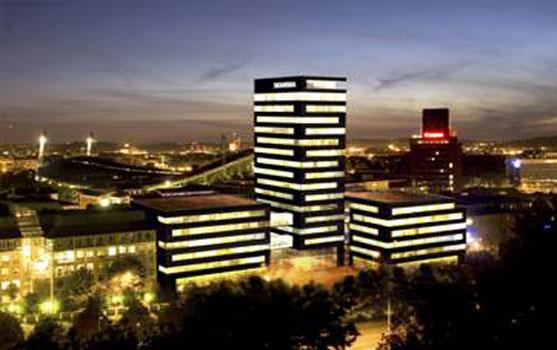
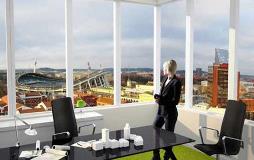
In the early stages of developing Gröna skrapan in Gothenburg, it was decided that the construction project should be as environmentally friendly as possible and the building itself should be optimally energy-efficient. Improving the energy efficiency of buildings is very important since buildings account for about 40% of society's total energy consumption. Gröna skrapan was required to remain 25% below the minimum requirements issued by Boverket (the Swedish National Board of Housing) for new construction. Achieving the highest level of environmental certification was another requirement that the building had to meet.
LEED certification is based on multiple criteria including e.g. the use of resources, the location and design of the building, indoor air quality, energy consumption and waste output. The level of environmental certification is determined by the total score the project earns in the LEED scoring system. There are four LEED levels: platinum, gold, silver, and certified. Energy consumption carries considerable weight in the LEED system be-cause buildings consume a significant proportion of the total energy used by society. Construction materials are rated on the basis of the sustainability of their production and transportation.
External wall element solution
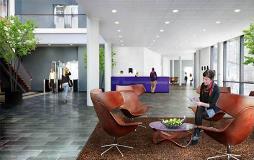
The environmental impact of the building was successfully reduced with several different solutions. The building draws its power from energy harvested locally from wind. The roof is covered in vegetation, mainly sedum plants. This green roof efficiently controls storm water runoff and filters the rainwater, thus preventing acid rain from polluting the waterways. Watersaving taps and toilets are used exclusively in the building. Energy is also effectively reclaimed from the outflow of the air conditioning system. Special attention has been paid to indoor air quality.
For the building's façade, Skanska selected Ruukki's prefabricated external wall elements with ready-installed rain screen panels. Ruukki supplied a total of 5,500 m2 of elements. This external wall element solution enabled Skanska to finish the project following the tight schedule while still meeting the strict requirements for thermal insulation, soundproofing and fireproofing.
Skanska selected Ruukki as the supplier of external wall structures for many reasons. Ruukki provided Skanska with some wall structures before construction was started so that their thermal insulation properties and air tightness could first be investigated and verified in a test module. The client was thus given the opportunity to evaluate the elements and pick the ones that were structurally and architecturally the most suitable. Skanska and Ruukki have a long history of collaboration in similar projects. Ruukki's environmental reporting, quality certification, environmental certification and CE markings meet the requirements of Skanska very well.
The installation method of the external wall elements ensures that the panels are very tightly joined at the seams. The wall elements have excellent thermal insulation properties. The interior surfaces of the elements installed in Gröna skrapan are made of steel sheets while the exterior surfaces are made of fibre cement windshield material. There is an insulation core between the interior and exterior surfaces.
Ecological efficiency and sustainable development
Energy efficiency achieved by structural air tightness was one of the key requirements set for the new office building by Skanska. Ruukki's wall elements are airtight and can be used to achieve leakage rates well below those laid down in building guidelines. By manipulating the thickness of the insulation layer, the building can be given insulation properties (as measured by the U-value) that meet the requirements.
For several years now, Ruukki has developed its production methods and products to comply with the principles of ecological efficiency andsustainable development. Ruukki's products are manufactured in part from recycled steel, and material loss is avoided to the highest degree possible. The amount of construction waste is minimised when ready-to-install components are used at the construction site. It is worth noting that steel is 100% recyclable.